The Beauty of Human-Machine Collaboration
Exploring the aesthetic possibilities that emerge when human creativity meets algorithmic precision.
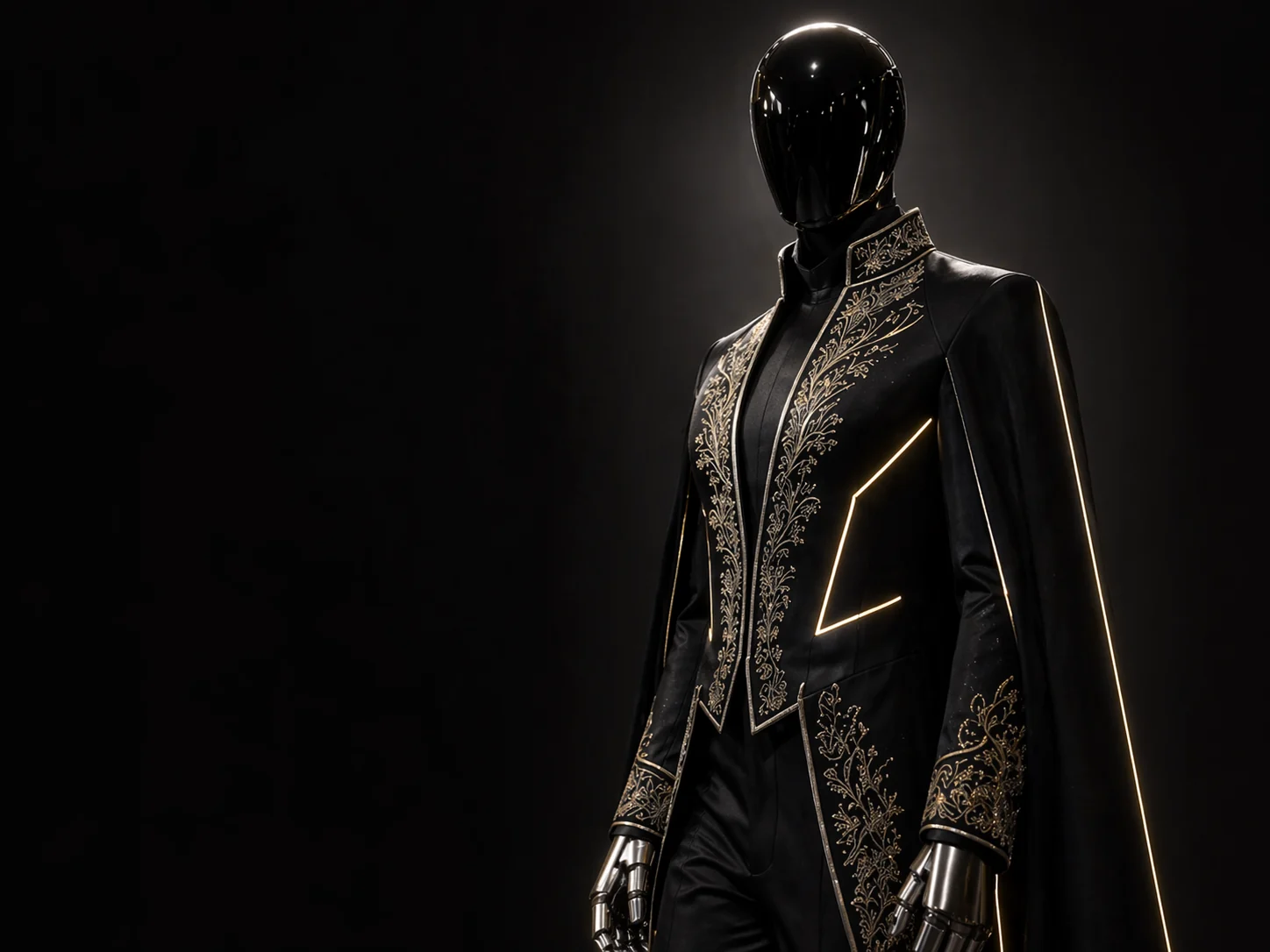
The Fear and the Promise
Every technological revolution in fashion has been met with the same fear: that the machine will replace the human. The mechanical loom, the sewing machine, computer-aided design—each innovation prompted predictions that craft would die, that mass production would erase artistry. Each time, the opposite occurred. New tools enabled new forms of beauty that were previously impossible.
We stand at another such threshold. Artificial intelligence and precision robotics offer capabilities that exceed human performance in specific domains: pattern recognition, consistent execution, tireless repetition. The fear is familiar: will the algorithm replace the designer? Will the robot replace the artisan?
The answer emerging from our work is not just "no" but something more interesting: the collaboration itself generates aesthetic possibilities that neither human nor machine could achieve alone.
Complementary Intelligences
Humans and machines think differently—not better or worse, but differently. Human cognition excels at holistic perception, emotional resonance, cultural context, and creative leaps. Machine intelligence excels at pattern analysis, precise execution, processing vast datasets, and maintaining consistency.
"The collaboration generates aesthetic possibilities that neither human nor machine could achieve alone."
These capabilities are not competitive but complementary. A human designer can envision a silhouette that evokes melancholy and strength; a machine can analyze thousands of garments to understand which specific proportions historically produce those associations. A human artisan can feel when a drape is right; a robotic arm can replicate that exact drape with superhuman precision across an entire production run.
The question is not which intelligence should lead but how to choreograph their interaction.
The Dance of Design
At ROBOTICS FASHION, our design process is genuinely collaborative. We begin with human intuition—a mood board, a emotional territory, a rough sketch of possibility. The AI systems then explore that territory, generating thousands of variations, finding connections and possibilities that no human would have time to consider.
But the AI doesn't decide. It proposes. The human designers review its suggestions, responding emotionally, filtering for beauty and meaning and cultural resonance. The selected directions return to the AI for refinement, then back to humans for evaluation, in an iterative dance that gradually converges on forms neither party would have reached alone.
The result is not human design assisted by AI, nor AI design approved by humans. It is a third thing—a hybrid aesthetic that emerges from the space between intelligences.
Precision as Poetry
Robotic execution enables aesthetic effects that hand-craftsmanship cannot achieve. Consider the gradient. A human artisan can create beautiful gradients—gentle transitions of color or texture across a garment. But even the most skilled hand cannot maintain mathematical precision across thousands of individual placements.
Our robotic systems can execute gradients where each element is placed with micron-level accuracy, creating transitions so smooth they appear to be continuous rather than discrete. The effect is not mechanical but magical—a perfection that reads as natural because it surpasses what we expect from human hands.
This is precision as poetry: not cold accuracy but a new form of beauty that technology enables.
The Irreplaceable Human
Having celebrated machine capability, I must also defend the irreplaceable role of human creativity. AI systems are, at their core, pattern-matching engines. They can recombine existing elements in new ways, but they cannot create from nothing. They have no dreams, no fears, no desire to express something inexpressible.
The human designer brings meaning—the why behind the what. A silhouette is not just pleasing proportions; it is an argument about how a body should move through space. A color is not just wavelength; it is an emotional proposition. These meanings emerge from human experience, human culture, human longing. No algorithm can generate them.
The machine amplifies, extends, and refines. The human originates, chooses, and means. Both are essential.
Aesthetic Implications
The collaboration produces distinctive aesthetic characteristics. Our work tends toward:
Hyperprecision: Details executed with accuracy beyond human capability, creating uncanny perfection.
Emergent complexity: Patterns and structures that emerge from algorithmic exploration but are selected for emotional resonance.
Responsive form: Garments that adapt and change, enabled by the integration of sensing and actuation that requires computational design.
Temporal beauty: Aesthetic effects that unfold over time, requiring computational choreography.
These are not human aesthetics produced with machine assistance. They are new aesthetic territories that the collaboration opens.
The Future Ensemble
I imagine a future where the human-machine partnership is so fluid that the question of who contributed what becomes meaningless. Designer, AI, and robotic systems will function as a single creative ensemble, each element essential to the whole.
This vision does not diminish the human—it elevates us. Freed from tasks that machines perform better, we can focus on what only we can do: dream, feel, mean. The collaboration does not replace human creativity; it gives it new wings.