Fashion, Technology, and the Future of Identity
What does it mean to dress in an age where garments can respond to—and reveal—our inner states?
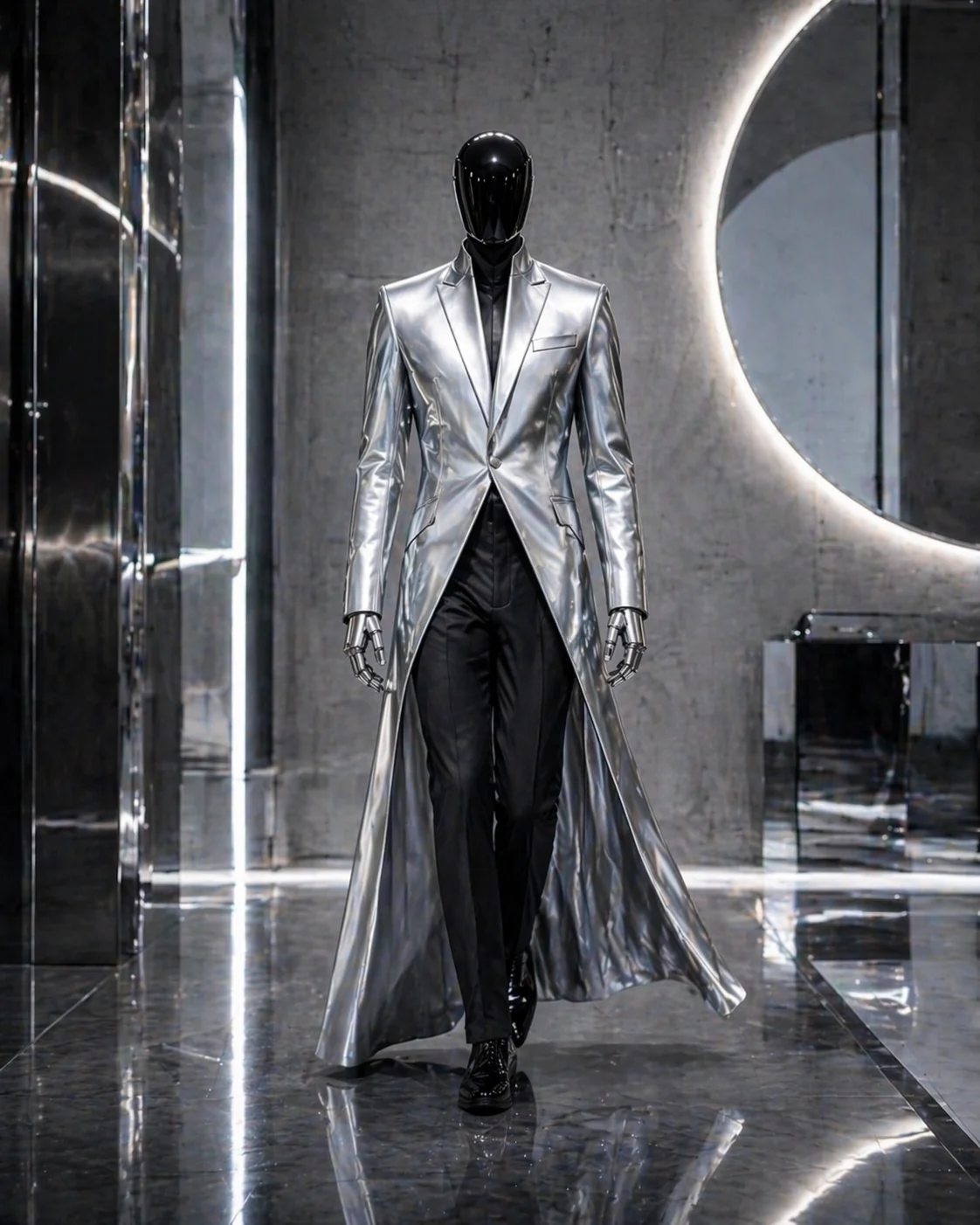
The Mask and the Mirror
Fashion has always served two opposing functions: the mask and the mirror. As mask, clothing conceals—hiding the body's imperfections, projecting an identity we wish to embody, creating distance between inner self and outer presentation. As mirror, clothing reveals—expressing authentic identity, signaling tribal belonging, communicating mood and intention.
These functions exist in perpetual tension. We dress to show who we are; we dress to become who we want to be. The same garment can perform both functions depending on the wearer's relationship to it and the viewer's interpretation.
Neural-responsive fashion disrupts this equilibrium. When a garment can read and display the body's bioelectric signatures—the physical correlates of emotion, arousal, attention—the mask becomes transparent. The mirror reflects not what we choose to show but what we are.
The Honest Garment
Consider what it means to wear a garment that changes color based on your emotional state. In a meeting, your anxiety is visible as a subtle flush. In a conversation, your genuine interest or boredom reads in real time. In a romantic encounter, the intensity of your feeling is literally on display.
For some, this transparency is liberating. No more performing emotions you don't feel. No more wondering if others are genuine. The honest garment creates honest interaction—or at least, it removes one layer of deception.
"When a garment can read and display the body's bioelectric signatures, the mask becomes transparent."
But honesty is not always kind, and masks serve important functions. We perform confidence when we feel uncertain because the performance itself can generate the reality. We conceal attraction because social contexts sometimes require it. We present calm when we feel panic because others depend on our stability.
The honest garment threatens these necessary performances. And so we face a choice our ancestors never imagined: do we want clothing that reveals us?
Agency and Control
At ROBOTICS FASHION, we've approached this challenge through the principle of radical agency. Our neural-responsive garments include comprehensive control systems. The wearer can:
- Enable or disable all responsive features - Set visibility thresholds (only display emotions above a certain intensity) - Define "public" and "private" emotional states - Create personal coding schemes (your anxiety might display as whatever color you choose) - Override the display manually at any moment
This control is not an afterthought but a core design principle. We believe the garment should amplify agency, not undermine it. The technology reveals only what you choose to reveal, when you choose to reveal it.
New Vocabularies of Self
Beyond the question of revelation lies a more generative possibility: neural-responsive fashion enables new forms of self-expression that were previously impossible.
Consider: you feel an emotion that has no name, no clear analog in language or gesture. With traditional clothing, this emotion remains inexpressible. But a neural-responsive garment can display the actual bioelectric signature of this feeling—not a symbol or approximation but the thing itself.
We are developing what we call "emotional vocabularies"—mappings between bioelectric patterns and visual displays that allow wearers to share internal states with unprecedented fidelity. Early adopters describe the experience as profound: "For the first time, I can show someone exactly how I feel, without words getting in the way."
This is not just communication; it is a new form of intimacy.
Identity Fluidity
Traditional fashion supports identity fluidity through costume—we dress differently for work and play, for mourning and celebration, for different versions of ourselves. But the identities we can perform are limited by the garments available and our skill in deploying them.
Neural-responsive fashion enables identity fluidity at a deeper level. The same garment can present radically different appearances based on the wearer's state. A single piece can be vibrant or subdued, structured or flowing, visible or nearly transparent—all in response to the wearer's continuously evolving internal experience.
The self is not fixed; the wardrobe need not be either.
The Social Fabric
Individual choices about self-revelation aggregate into social norms. If neural-responsive fashion becomes widespread, we face questions about what displays become expected or required. Will employers demand visible engagement? Will partners expect emotional transparency? Will social settings require certain levels of disclosure?
These are not technological questions but political ones. Technology creates possibilities; societies decide how those possibilities are actualized. At ROBOTICS FASHION, we advocate for norms that center individual choice—but we acknowledge that our advocacy is itself a political position.
The Augmented Self
Perhaps the most profound implication of neural-responsive fashion is the potential for augmentation—not just revealing the self but enhancing it.
Our garments don't just display emotional states; they can influence them. Gentle compression responds to anxiety. Warming responds to cold. Subtle haptic feedback encourages mindful breathing. The garment becomes not just a mirror but a partner in emotional regulation.
This raises the question: where does the self end and the garment begin? If my clothing helps me feel calm, am I genuinely calm or technologically assisted? If my confidence is supported by structural elements that make me stand taller, is it authentic confidence?
We believe these questions have always been present in fashion—clothing has always shaped how we feel as well as how we appear. Neural-responsive fashion simply makes explicit what was always implicit: the garment participates in the construction of the self.
Designing for Humanity
At ROBOTICS FASHION, we approach these questions with humility and intention. We don't claim to have answers, but we are committed to asking the right questions:
- Does this technology enhance or diminish human agency? - Does it create new possibilities for authentic self-expression? - Does it respect the complexity and privacy of inner experience? - Does it serve the wearer rather than demanding the wearer serve it?
Fashion has always been entangled with identity—a technology of self-presentation as old as human culture. What changes now is the intimacy of that entanglement and the power of the tools involved.
The garment of the future will not just adorn identity; it will participate in its construction. The only question is whether we will shape this participation thoughtfully—or let it shape us.