Craftsmanship in the Age of Robotics
How precision engineering amplifies rather than replaces the human touch in haute couture. A conversation with our master artisans.
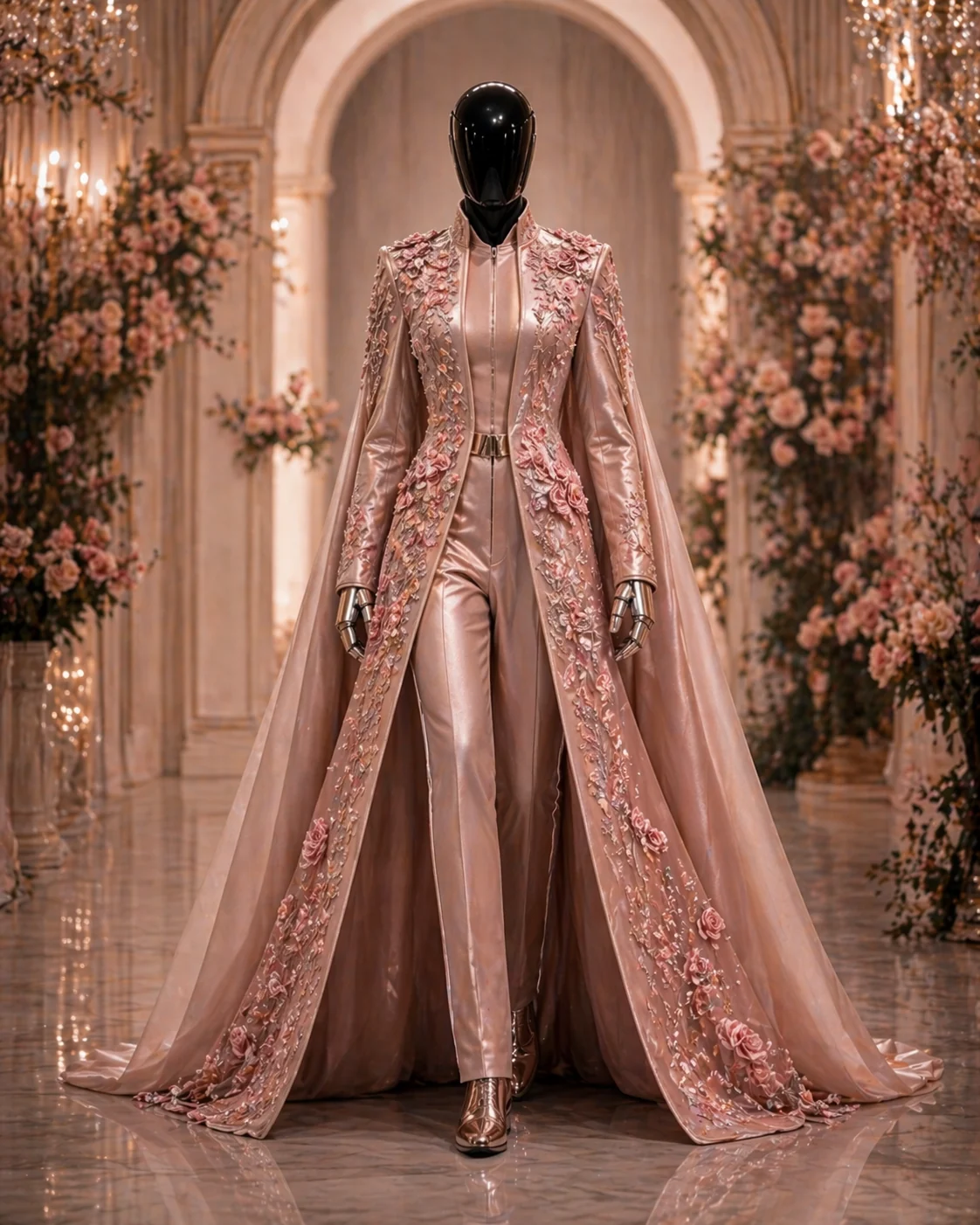
A Conversation with Isabelle Monet, Master Artisan
Marcus Chen sits with Isabelle Monet in the atelier's hand-finishing room, where traditional couture techniques meet precision robotics. Light streams through tall windows onto worktables where artisans guide robotic arms through the most delicate operations.
Marcus Chen: Isabelle, you trained in the great Parisian ateliers. When you first saw a robotic arm in a couture workshop, what did you think?
Isabelle Monet: Honestly? I was horrified. I thought it was the end of everything I had devoted my life to learning. The hand, the human hand—this has always been sacred in haute couture. Each stitch carries the energy of the person who made it. How could a machine replicate that?
MC: And now?
IM: Now I understand I was asking the wrong question. The machine doesn't replicate the human hand—it extends it. When I guide our robotic systems through a seam, I am still the one making the creative decisions. But I can achieve a precision that my fingers alone could never accomplish. The partnership makes both of us better.
The Marriage of Precision and Soul
MC: Can you give me a specific example?
IM: Consider the micro-pleating we do for our Neural Couture collection. Traditional pleating is already incredibly demanding—you're folding fabric at intervals measured in millimeters. But for neural-responsive fabric, we need pleats that are exactly 0.3 millimeters apart, with consistency across an entire garment. No human hand, no matter how skilled, can maintain that precision for hours. The fabric's electronic properties depend on it.
MC: So the robot handles the precision while you handle...?
IM: The intention. The robot doesn't know why we're pleating, or what emotional response we're trying to evoke, or how this particular piece fits into the client's wardrobe and life. I do. I choose where the pleating begins and ends, how it flows with the body, where we allow slight variations for visual interest. The robot executes my vision with superhuman accuracy.
"The robot doesn't know why we're pleating, or what emotional response we're trying to evoke. I do."
Training the Next Generation
MC: How do you train young artisans in this hybrid approach?
IM: We start them exactly where I started—with hand techniques. Every artisan at ROBOTICS FASHION must master traditional couture before they touch a robotic interface. You cannot direct a machine through a French seam if you've never done one yourself. The knowledge has to live in your body first.
MC: That seems counterintuitive in a company focused on technology.
IM: It would be counterintuitive if we were trying to replace human craft. We're not. We're trying to elevate it. A pianist who has never played on an acoustic instrument cannot truly master an electronic one—they don't understand what they're simulating. The same is true here.
The Question of Authenticity
MC: Critics sometimes suggest that robotically-assisted garments aren't "authentic" haute couture. How do you respond?
IM: I ask them to define authenticity. Is a garment less authentic because we used electric sewing machines instead of hand-cranked ones? Because we source silk from Japan instead of France? The definition of authenticity in couture has always evolved with technology.
What makes haute couture authentic is the intention behind it—the commitment to creating something unique for a specific client, the refusal to compromise on quality, the human creativity that guides every decision. None of that changes because we've added new tools to our workshop.
MC: What's the most beautiful moment in your hybrid practice?
IM: When the robot pauses, waiting for my next instruction, and I realize that I'm about to attempt something that has never been done before—a technique that requires both my decades of experience and the robot's impossible precision. In that moment, I am not competing with the machine. We are collaborating on something neither of us could achieve alone.
Looking Forward
MC: Where do you see this collaboration heading?
IM: I dream of a day when every artisan has a robotic partner as sophisticated as a musical instrument. Something that responds to subtle gestures, that learns their personal style, that amplifies their unique gifts. We are building that future piece by piece, stitch by stitch.
But I also believe we must remain humble. The machine is powerful, but it is not creative. It is not ambitious. It does not lie awake at night thinking about how a sleeve should fall. That remains our sacred responsibility—and our profound privilege.